
Six Five Minute Activities (that are never five minutes)
Oldies but goodies.

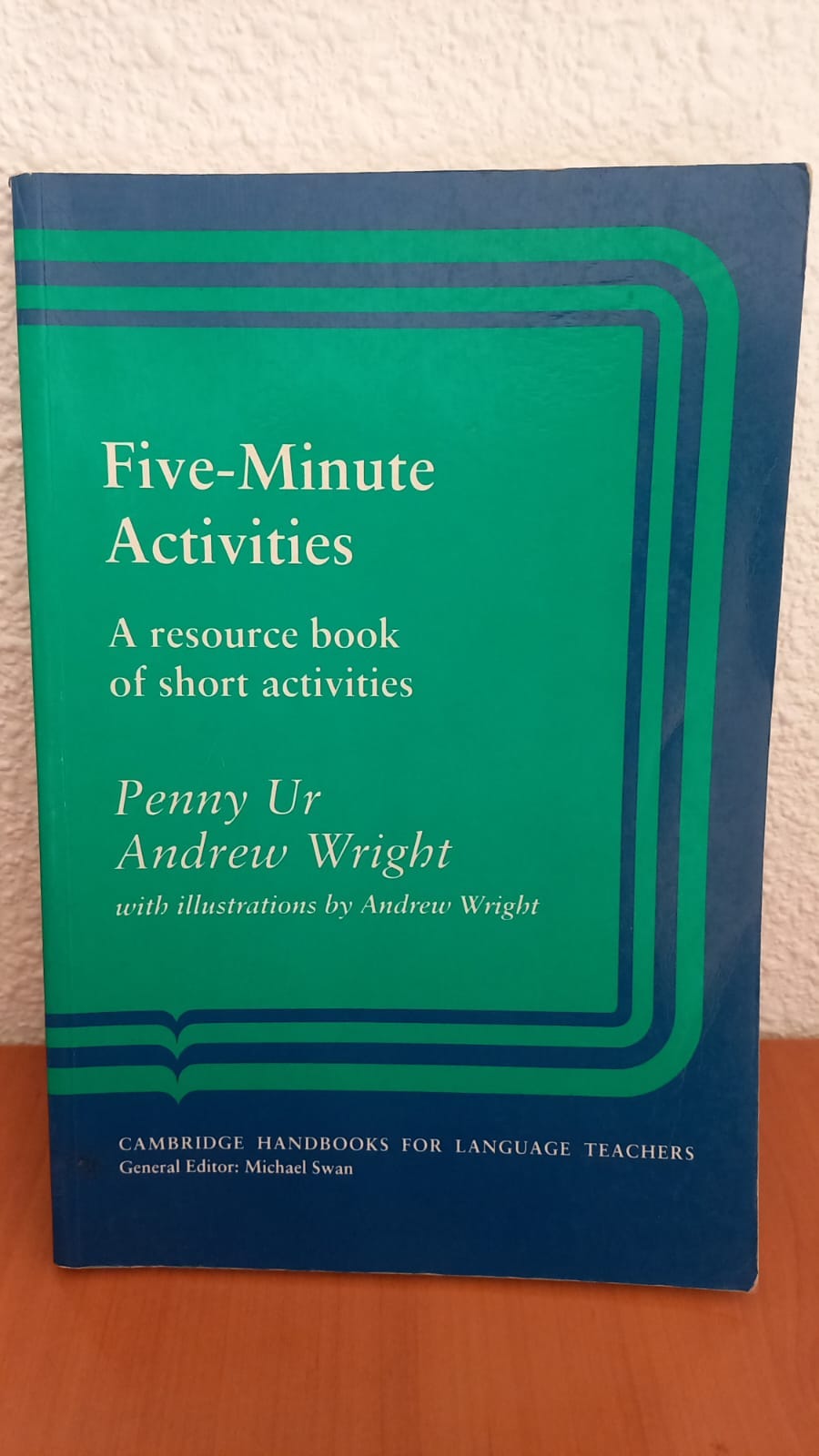
Note: this is a repost/update of something I wrote for the original Six Things, about one of the classic teacher resource books which happened to be one of the first ones I owned and used until the pages almost fell out. I may pick up a new updated copy at IATEFL next week.
On the shelf in front of me is my old, battered edition of Five Minute Activities by Penny Ur and Andrew Wright. When I started teaching - before YouTube, before Google, before getting resources online was even a thing- this and Grammar Games by Mario Rinvolucri were my only two resource books. I’ve used so many of the activities in here that they feel like old friends. There are two things about the activities in this book that I’d like to mention: 1) they are very sensible and doable in almost all teaching contexts; and 2) they often last longer than five minutes. Both these are compliments, I hastily add! I love elastic activities that could be five or twenty-five minutes depending on the level and interest of the students. I thought I’d share half a dozen of my favourites:
1 Adjectives and nouns
Students suggest adjective and noun combinations such as a rainy day, a tidy room. You write these up on the board and add some yourself. The students then have to use these words to suggest different combinations (e.g. a tidy day, a rainy room). If someone makes an unusual suggestion then they have to justify it.
2 Delphic dictionary
Students suggest some typical problems, which you write on the board. A student chooses one of these problems, and then is asked to open an English-English dictionary at random and put their finger on the page. The word they indicate has to form part of the solution. I let students choose a word on the page, in case they really fall on a really hard word. Of course you need a paper dictionary for this activity, you might be hard pressed to find one in a classroom these days.
3 Match the adjectives
Another adjective activity! This time you write three words on the board e.g. important, heavy, dangerous. Students have to suggest a word that goes with all three (e.g. an army, a car, a plane…). There is a really good list of groups of adjectives to go with this. What, for example, could be small, loud and fat?
4 Odd one out
Write a list of six words on the board from a lexical set. Students have to decide which one is the odd one out. They must explain why. Once they have, then challenge them to nominate another one which could be the odd one out for different reasons. This activity is great for lateral thinking. The variation is great too, where every time they argue one is the odd word out you cross it out and they repeat the activity with the words left until there are only two words. This takes far, far longer than five minutes for my classes. Sample lists are provided in the book.
5 Spelling bee
A spelling competition is hardly an earth-shatteringly original activity. And it usually takes longer than five minutes in my experience. But my classes have had lots of fun with this, and they often consider it useful. The best part is the authors have listed a whole bunch of words that are commonly spelled wrongly at various different levels. Priceless little resource to have at hand.
6 Wrangling
I love this activity. Write a two line dialogue on the board. My favourite of the ones suggested is
A: Still, I think you’d better tell them.
B: Oh, no, they’ll kill me.
Students have to say the lines together, as an argument. They can repeat the lines as many times as they like but they cannot add anything else. They must vary stress, intonation and gesture to convince each other. After a few exchanges I’ve seen students really get heated up and in fact their delivery of the lines becomes much better. Leads on to a good discussion of what the context and who the speakers might be (again, longer now than five minutes).
There are many many more in the book that are just as good, it was hard to choose only six! A little footnote to this post: one year at an IATEFL conference Penny Ur explained a reading activity during a talk, and she used me as the subject of the activity. Wow. Call me an ELT nerd if you like (do it quietly please), but it was a bit like having your favourite singer suddenly belt out a song with your name in it during a concert.
Does anyone else have a favourite five minute activity (from this book or your own)? Let me know in the socials.